News
China Component Sourcing in 2026: The Market Has Changed. So Have the Risks. Updated August 17, 2026 By LINSION
China Component Sourcing in 2026: The Market Has Changed. So Have the Risks.
Updated August 17, 2026
By LINSION Market Intelligence Team
China’s electronic-component market in 2026 is neither the emergency sourcing environment of 2021 nor a simple return to the pre-COVID market.
Global semiconductor demand is accelerating again. China’s electronics and integrated-circuit output continues to expand. Buyers have more sourcing options than they did during the global chip shortage, but the risks have also changed.
During COVID-19, the central question was often:
Can we find the stock before production stops?
In 2026, a more useful set of questions is:
Is the stock real? Where did it come from? What is its actual condition? Can the documentation be verified? And does the transaction make sense for the buyer’s application, destination and compliance requirements?
Those differences matter because sourcing from China today offers significant flexibility—but that flexibility should not be confused with certainty.
Key Findings
The COVID-era semiconductor shortage was not simply caused by chip factories stopping production. In 2021, the industry actually shipped a record 1.15 trillion semiconductor units, while demand rose faster than effective supply could respond. [1][2]
The 2026 semiconductor market is growing extremely quickly, but that growth is highly concentrated. WSTS currently forecasts Memory to grow around 250% in 2026, compared with 10% for Analog, 8% for Discrete Semiconductors and 3% for Sensors and Optoelectronics. [5]
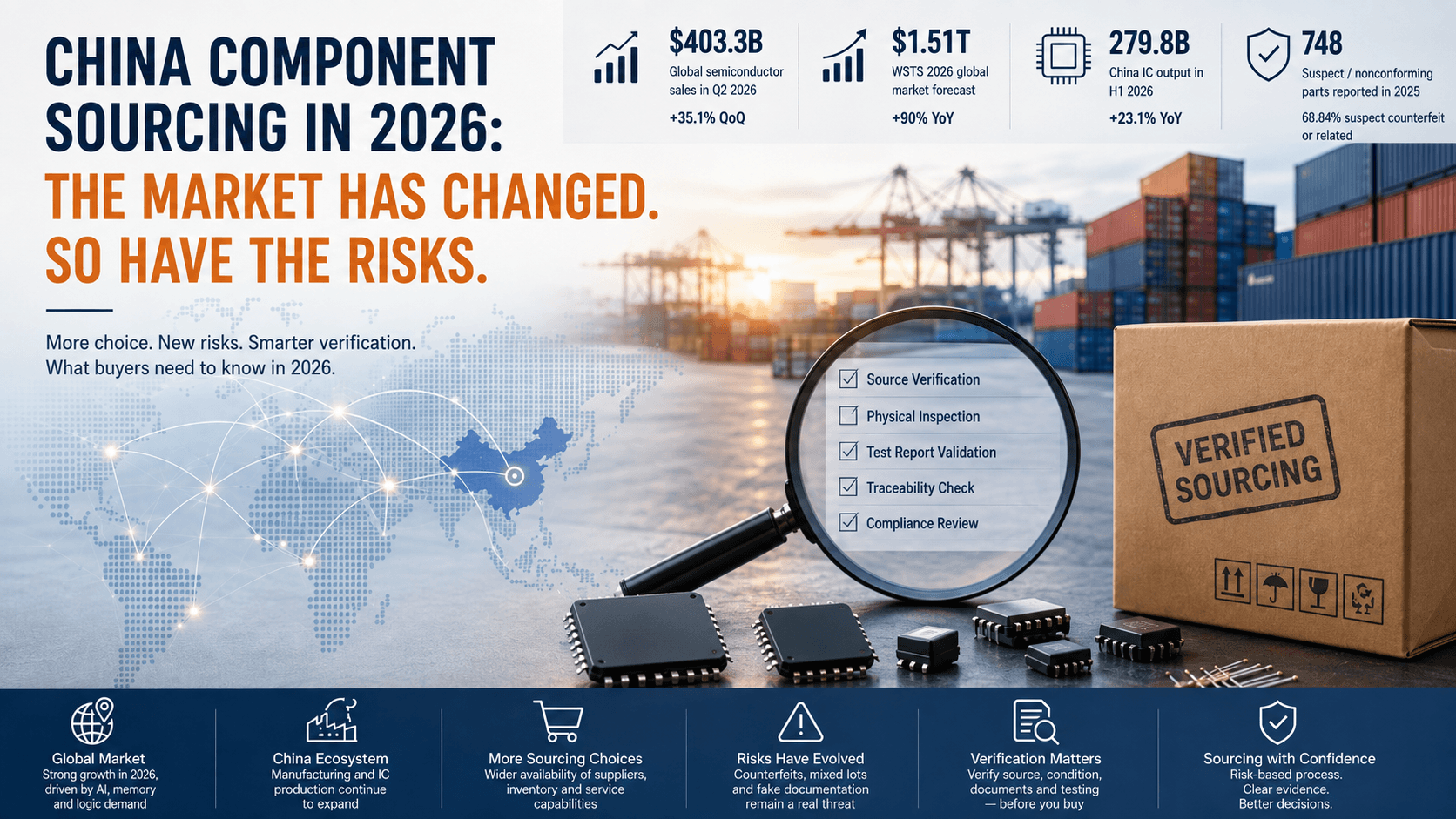
China remains a major electronics-production ecosystem. In the first half of 2026, China produced 279.8 billion integrated circuits, up 23.1% year on year, while value added in computer, communication and other electronic-equipment manufacturing increased 14.8%. [6]
Counterfeit and nonconforming risks have not disappeared. ERAI reported 748 parts in 2025; 36.15% of reported parts were active components rather than obsolete products, and 81.1% were part numbers being reported for the first time. [7]
In 2026, verification increasingly needs to include not only the physical component but also test reports, certificates, traceability information and other supporting documents. [8]
How COVID-19 Changed Component Sourcing
The semiconductor shortage that developed during the pandemic is sometimes described too simply: factories closed, production fell and buyers moved their orders to China.
The actual situation was more complicated.
Temporary factory shutdowns, labour restrictions and logistics disruptions did affect semiconductor production and delivery. However, the industry was simultaneously increasing output.
In 2021, global semiconductor sales reached US$555.9 billion, up 26.2% from 2020, while manufacturers shipped a record 1.15 trillion semiconductor units. China was also the largest individual semiconductor market that year, with sales of US$192.5 billion. [1]
The shortage therefore cannot be explained simply as a collapse in semiconductor production.
Demand had changed faster than supply could respond.
Remote work, online education, cloud infrastructure, consumer electronics and other digital activities increased demand for many types of electronic equipment. At the same time, automotive and industrial demand recovered, while semiconductor manufacturing capacity could not be expanded or reassigned immediately.
A fabrication line designed for one process or product group cannot automatically solve a shortage affecting another technology.
The U.S. Department of Commerce estimated that semiconductor demand in 2021 was as much as 17% higher than in 2019. More importantly, the median semiconductor inventory held by surveyed buyers fell from approximately 40 days in 2019 to fewer than five days in 2021. [2]
That left manufacturers extremely sensitive to even relatively short disruptions.
Procurement behaviour amplified the shortage further. Companies increased safety stocks, ordered earlier and sometimes placed orders through multiple channels because they did not know which supplier would actually deliver.
This “bullwhip effect” increased apparent demand and intensified pressure on already constrained supply chains.
Why More Sourcing Activity Reached China
China was particularly well positioned during this period because its manufacturing and export activity recovered relatively early.
UN Trade and Development reported that by mid-2020, Chinese exports had already returned above pre-pandemic levels, faster than those of many other economies. [3]
But China’s role should not be misunderstood.
It was not simply replacing semiconductor production in other countries.
China had—and still has—a dense ecosystem connecting:
electronics manufacturing;
OEM and EMS operations;
authorized and independent distribution;
surplus and excess inventory;
component trading;
testing and inspection;
packaging;
international logistics.
When buyers could not obtain enough material through their regular channels, this ecosystem made China one of the places where alternative inventory could be searched, inspected, consolidated and exported.
For some overseas companies, this was their first meaningful exposure to China’s independent component market.
The Shortage Also Changed Market Incentives
A severe shortage changes the value of inventory.
A supplier holding genuine stock of a component that can prevent a production-line shutdown may legitimately earn more than during a stable market.
That does not automatically mean the supplier is exploiting the buyer.
Spot-market suppliers can take real commercial risks: purchasing inventory before an order is confirmed, reserving stock while prices move, accepting cancellation exposure and carrying material whose market price may decline quickly.
During COVID-19, however, these legitimate scarcity premiums existed alongside another problem: information asymmetry became unusually valuable.
A buyer urgently searching for a difficult component often had less time to:
investigate a new supplier;
confirm the upstream source;
inspect the full quantity;
compare market prices;
conduct extensive testing;
verify documents before payment.
As a result, the same market that rewarded legitimate inventory holders also created stronger financial incentives for dishonest sellers.
Some transactions involved nonexistent inventory, misrepresented product condition, recycled components sold as new, remarking, mixed lots, counterfeit products or other nonconforming material.
It is important not to exaggerate this point.
There is no reliable industry-wide dataset showing exactly how many people entered China’s component-trading sector during the shortage, nor is there credible evidence establishing a standard profit margin for legitimate sellers or counterfeiters.
Claims such as “normal suppliers made 5–10% while counterfeiters made 80%” may describe individual experiences, but they should not be presented as industry statistics.
The stronger conclusion is economic rather than psychological:
The shortage increased the commercial value of both genuine inventory and information asymmetry. That rewarded capable suppliers, while also creating more attractive opportunities for opportunistic and fraudulent behaviour.
2026 Is Not Simply “Chip Shortage 2.0”
The semiconductor market is booming again—but the structure of this growth is very different.
On August 6, 2026, the Semiconductor Industry Association reported that worldwide semiconductor sales reached US$403.3 billion in Q2 2026, an increase of 35.1% from Q1.
June alone recorded US$134.5 billion in worldwide semiconductor sales, up 123.6% year on year. [4]
Those numbers might suggest another universal component shortage.
That would be the wrong conclusion.
WSTS currently forecasts the global semiconductor market to reach approximately US$1.51 trillion in 2026, representing around 90% annual growth. But the growth rates by product category are dramatically different:
Semiconductor CategoryWSTS 2026 Growth ForecastMemory~250%Logic~37%Microprocessors~20%Analog~10%Discrete Semiconductors~8%Sensors & Optoelectronics~3%
Source: WSTS Spring 2026 Forecast. [5]
This distinction is critical for component buyers.
A booming semiconductor market does not mean every component is becoming scarce.
Much of the current acceleration is linked to AI infrastructure, high-bandwidth memory, data centres and advanced computing.
That is very different from the COVID-era environment, when disruptions, depleted inventories and procurement uncertainty affected a much broader range of electronics supply chains.
In 2026, one product family may experience rapid price increases while another remains readily available.
A Memory component, FPGA, MCU, analog IC, relay and connector should therefore not be treated as if they belong to one market cycle.
The market is increasingly part-number specific.
China Has Not Become Less Relevant After COVID
Another incorrect assumption is that China became important for component sourcing only because of the pandemic.
Current production data suggests otherwise.
According to China’s National Bureau of Statistics, during the first half of 2026:
output of integrated circuits reached 279.8 billion units, up 23.1% year on year;
value added in computer, communication and other electronic-equipment manufacturing increased 14.8% year on year;
high-technology manufacturing value added increased 13.3%. [6]
These figures do not mean that every component offered by a Chinese distributor was manufactured in China.
That distinction is essential.
A Shenzhen supplier may be offering products manufactured in Malaysia, Thailand, the Philippines, Japan, Taiwan, Europe, the United States or elsewhere.
What the data does show is that China continues to have a large and expanding electronics-production ecosystem.
Its role in international sourcing therefore goes beyond domestic semiconductor manufacturing.
The practical advantage is the concentration of manufacturing, inventory, trading, inspection and logistics capabilities within one broader supply network.
More Choice Does Not Automatically Mean Less Risk
The difference between 2021 and 2026 is that buyers generally have more options for many mainstream components.
But counterfeit and nonconforming risks remain.
ERAI’s latest complete annual dataset, published in May 2026, recorded 748 parts reported as suspect counterfeit, nonconforming or related classifications during 2025. [7]
The total was 29.1% lower than 2024, but the comparison requires context: 2024 included a single batch of 248 parts reported by the U.S. Government. Removing that exceptional batch reduces the year-on-year decline to only 7.4%. [7]
The composition of those reports is more useful than the headline number.
ERAI classified:
55.34% as Suspect Counterfeit;
31% as Nonconforming;
13.5% as both Nonconforming and Suspect Counterfeit.
Taken together, 68.84% included a Suspect Counterfeit classification. [7]
More importantly, the assumption that counterfeiters only target obsolete or extremely scarce components is not supported by the data.
Although obsolete parts represented 60.02% of reported components, active components still accounted for 36.15% of parts reported to ERAI in 2025. [7]
Another 81.1% of reported part numbers were new occurrences—meaning they had not previously appeared in ERAI’s reported-parts data. [7]
The practical implication is simple:
A part being active, widely available or previously absent from counterfeit databases does not by itself establish that a particular lot is low risk.
The Risk Is No Longer Just the Physical Component
One of the more relevant developments in 2026 concerns documentation.
In April 2026, ERAI described a case involving counterfeit test reports that were allegedly issued by a third-party laboratory.
The laboratory subsequently confirmed that it had not performed the claimed testing on the components. ERAI used the case to emphasize that companies should independently validate test reports, certificates and other supporting documentation rather than assuming that a document supplied by an upstream seller is authentic. [8]
This represents an important evolution in sourcing risk.
A component may look correct.
A label may look correct.
A PDF test report may also look correct.
But none of those items should automatically be treated as independent proof of the others.
Buyers increasingly need to consider the integrity of the evidence chain, not only the product itself.
That may include:
Component → packaging → label → lot information → source → inspection → laboratory report → commercial documentation
A break anywhere in that chain can change the risk profile of the transaction.
Testing More Does Not Always Mean Testing Better
Another lesson from current counterfeit data is that a single test cannot answer every question.
ERAI reported that 24% of suspect-counterfeit parts in its 2025 analysis passed electrical testing. It therefore cautioned that electrical testing alone may fail to identify some suspect counterfeit components. [7]
This does not mean every component should automatically undergo X-ray, decapsulation and full electrical testing.
That approach would be expensive and unnecessary for many purchases.
A stronger method is risk-based verification.
Current U.S. Department of Defense counterfeit-part requirements similarly call for risk-based policies covering supplier selection, inspection and testing, traceability, reporting, counterfeit-detection methods and control of obsolete parts. [9]
The appropriate inspection level should therefore depend on factors such as:
source;
traceability;
product value;
market availability;
lifecycle status;
physical condition;
application;
lot size;
consequences of failure.
A low-value active component from a highly traceable source and an obsolete FPGA purchased on the open market should not automatically receive the same inspection plan.
In 2026, Country of Origin and Compliance Matter More
Price and quality are no longer the only variables in international component sourcing.
Trade policy has become another important consideration.
For example, current U.S. Section 301 measures include an existing 50% additional tariff on specified semiconductor products of China. A separate Section 301 action announced in December 2025 currently has an initial additional rate of zero but is scheduled to increase on June 23, 2027, with the future rate to be announced beforehand. [10]
This highlights an important distinction:
Supplier location is not the same as product origin.
Buying from a supplier in Shenzhen does not automatically mean that every semiconductor in the shipment is of Chinese origin.
For international buyers, sourcing decisions may therefore need to consider:
Who is selling the component?
Where is the physical stock?
Who manufactured it?
What is the country of origin?
Where is the product being imported?
What end-use or compliance requirements apply?
Tariff and regulatory treatment varies by product, origin, classification and destination, so buyers should verify requirements applicable to their own transactions rather than applying one rule to all China-based sourcing.
So What Are the Advantages of Sourcing Components from China in 2026?
The advantages remain real.
But they are different from the simple “China is cheaper” argument often used in sourcing articles.
1. Sourcing Reach
China’s electronics ecosystem gives buyers access to a broad mix of manufacturers, distributors, OEM/EMS surplus inventory, independent-market inventory and supporting services.
This can be particularly useful for multi-brand BOMs and difficult-to-source items.
2. Speed of Market Search
A dense supplier network can make it possible to compare multiple potential sources quickly, particularly when normal distribution channels cannot provide the required quantity or date code.
3. Flexible Quantities
Independent sourcing can provide options for quantities or packaging conditions that standard authorized distribution does not always accommodate efficiently.
4. Physical Verification Before Export
When stock and inspection resources are geographically close, buyers can arrange photographs, physical inspection, sampling and third-party testing before material is shipped internationally.
5. Access to Secondary and Surplus Inventory
China’s large manufacturing base creates legitimate excess, surplus and project inventory.
When properly disclosed and verified, these sources can provide useful alternatives for maintenance, obsolete-product support and constrained BOMs.
But none of these advantages eliminates the need for due diligence.
What Should a Buyer Actually Verify?
The following framework is more useful than simply asking whether a supplier is “reliable.”
QuestionWhy It MattersPossible EvidenceDoes the stock actually exist?Prevents decisions based on copied or outdated inventoryCurrent photos, quantity evidence, warehouse verificationWhat is the source type?Different sources carry different traceability levelsOCM, authorized distribution, OEM/EMS surplus, independent marketWhat is the real condition?“Original” does not automatically mean “factory new”Visual inspection, packaging review, lot assessmentDo labels and parts match?Detects mixed lots and inconsistenciesLabel, date code, package, marking and physical comparisonIs the documentation genuine?Fake reports can accompany questionable materialDirect verification with issuing laboratory or organizationWhat testing is appropriate?One test does not detect every riskRisk-based inspection and laboratory planWhat is the country of origin?May affect tariffs and import requirementsOrigin information and customs classificationWhat happens if the material fails?Quality control without commercial responsibility is incompleteWritten warranty, return and dispute terms
The objective is not to remove every possible risk.
That is rarely realistic in an open-market transaction.
The objective is to make the remaining risk visible, proportionate and commercially understood before the buyer commits.
China Sourcing in 2026: A Different Value Proposition
During the COVID-era shortage, the strongest value proposition of China’s component market was often straightforward:
There may be stock here when your regular supplier has none.
That remains relevant for certain products, but it is no longer enough.
The 2026 market is more complex.
Global semiconductor demand is expanding rapidly, but growth is concentrated in specific technologies. China’s electronics manufacturing ecosystem continues to grow. Mainstream buyers have regained sourcing options in many categories, while counterfeit and nonconforming risks have become more targeted and sometimes more difficult to identify.
Documentation, origin and compliance now matter alongside price, availability and product condition.
For that reason, the most useful question is no longer:
Is sourcing electronic components from China safe?
There is no meaningful yes-or-no answer.
A better question is:
For this specific part number, source, lot and application, what can actually be verified before the order moves forward?
That is the difference between simply finding inventory and making an informed sourcing decision.
References
[1] Semiconductor Industry Association (SIA).
Global Semiconductor Sales, Units Shipped Reach All-Time Highs in 2021 as Industry Ramps Up Production Amid Shortage. February 14, 2022.
[2] U.S. Department of Commerce.
Results from Semiconductor Supply Chain Request for Information. January 25, 2022; related CHIPS Act supply-chain analysis, April 2022.
[3] UN Trade and Development (UNCTAD).
Impact of the COVID-19 Pandemic on Trade and Development: Lessons Learned. 2022.
[4] Semiconductor Industry Association (SIA).
Global Semiconductor Sales Increase 35.1% from Q1 2026 to Q2 2026. August 6, 2026.
[5] World Semiconductor Trade Statistics (WSTS).
Global Semiconductor Market Surges Beyond $1.5T 2026 — Spring 2026 Forecast. 2026.
[6] National Bureau of Statistics of China.
Industrial Production Operation in June 2026. July 16, 2026.
[7] ERAI, Inc., Damir Akhoundov.
2025 Annual Report. May 15, 2026.
[8] ERAI, Inc., Anne-Liese Heinichen.
When Documentation Becomes THE Risk — Lessons from a Counterfeit Test Report Case. April 28, 2026.
[9] U.S. Department of Defense, Defense Federal Acquisition Regulation Supplement (DFARS).
246.870-2 Policy and 252.246-7007 Contractor Counterfeit Electronic Part Detection and Avoidance System. Current DFARS change effective May 7, 2026.
[10] Office of the United States Trade Representative / Federal Register.
Notice of Action: China’s Acts, Policies, and Practices Related to Targeting of the Semiconductor Industry for Dominance. December 29, 2025.
Sources and publicly available data reviewed through August 17, 2026.
About LINSION
LINSION is a Shenzhen-based electronic component sourcing company serving OEM, EMS and industrial buyers worldwide. Our work covers ICs, relays and other electronic components, including spot sourcing, BOM support, stock verification and coordination of third-party quality inspection.
We focus on helping buyers make clearer sourcing decisions by improving visibility around stock availability, product condition, source information and transaction risk.